Ten Hours
On the shrinking gap between disclosure and exploitation — and what vDefend’s April update actually means for the people running the change board.
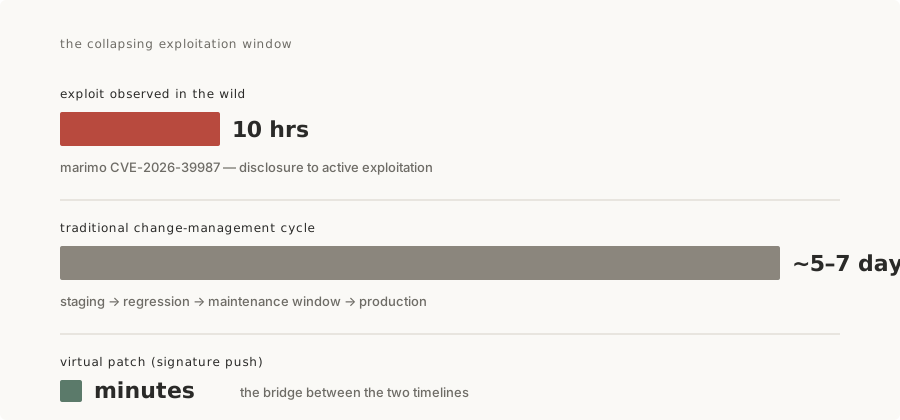
Picture the change-board meeting on a Monday morning. Someone pulls up a fresh critical RCE in a library that three of your production services use. The room does the math everyone in it already knows: staging tomorrow if QA clears the tests, pre-prod Wednesday if the app team can carve out ten minutes, production Friday at the earliest — assuming nothing else cuts in line. A week, give or take. That was the world until about eighteen months ago.
That window has gotten much shorter. A Python notebook tool used on a lot of data-science teams was under active attack ten hours after its CVE went public this month. An Apache message broker hit CISA’s actively-exploited list within days of disclosure. Microsoft’s April Patch Tuesday carried an Active Directory flaw that a low-privileged logged-in user can fire from an adjacent network — a textbook lateral-movement bug, sitting inside the service that most east-west trust is built on. None of this is rare anymore. It’s the new pattern.
The people running the change board aren’t slow. Staging, regression tests, maintenance windows, app-owner sign-offs — that’s real work, not red tape. The problem is that the attacker’s side of the timeline got faster, and the defender’s side didn’t. That’s the exact gap VMware’s security team wrote about on April 11. Their post frames the next few years as a wave of AI-discovered exploits and puts vDefend’s virtual patching in the middle — as the bridge between “we know about the bug” and “we’ve shipped the patch.” Read it as a product post if you want, but the underlying point is the one practitioners have been working through for months.
What virtual patching actually is
The idea is old. What’s new is where it now runs. You leave the vulnerable service up. You don’t push a code change. Instead, you block the exact traffic pattern the exploit uses — at the network layer, before it ever reaches the app. The bug stays in the code. The ability to exploit it, over the network, doesn’t.
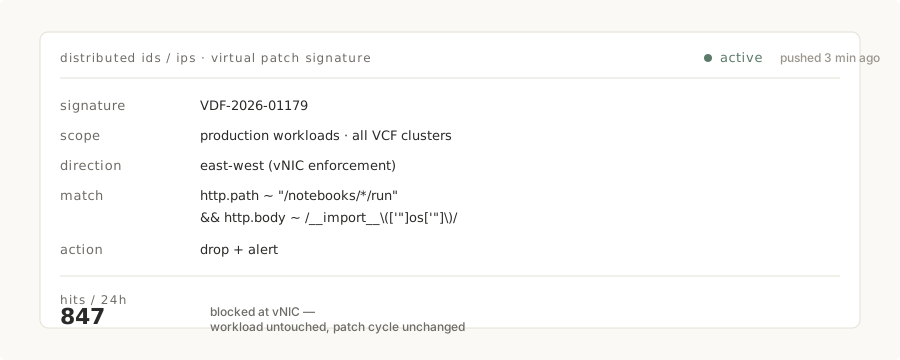
This has always been a WAF or perimeter IDS/IPS job, and north-south it still is. What vDefend adds is the same idea applied at the vNIC of every workload running on VCF. Distributed IDS/IPS sits inside the hypervisor, sees every packet each workload sends and receives, and can block a given exploit pattern as soon as a signature ships — on whatever schedule the vDefend signature feed uses. That schedule isn’t your change-management schedule, which is the whole point.
The April 11 post walks through a concrete example: a recent exploit against the n8n automation platform, blocked by a signature that matches the malformed JSON payloads and header mismatches the exploit relies on. The n8n service keeps running. The real patch lands when it lands. In between, the workload can’t be exploited over the network. That’s what a virtual patch looks like when it works.
Where it fits with the rest of the stack
Virtual patching on its own isn’t a full answer, and the post doesn’t oversell it. It’s one piece. The piece that fits it best is east-west containment on the distributed firewall.
Signatures catch what’s already known. A policy that limits which workloads can talk to which other workloads catches what isn’t. A DFW rule that says production Kubernetes namespaces don’t take inbound from developer VDIs is a small rule — but it’s the kind of rule that makes the Active Directory-class lateral-movement bug far less useful, because now the attacker has to find a workload pair you actually allow before they can move at all. The rule follows the workload; it doesn’t break when a VM moves.
NDR, the third leg, is there for the signatures you don’t have yet. AI-generated exploit variants will slip past fixed signatures — that’s what “AI-discovered exploits” means for the defender. What those variants won’t slip past as easily is behavior: beaconing, service scanning, logins from places that have never logged in before. That’s where the east-west traffic analysis in vDefend NDR earns its keep — not as a front-line block but as the backstop that catches the kind of attack you couldn’t write a signature for up front. Detection without enforcement is a ticket queue. Enforcement without detection is a rule that ages badly. The pair does the work.
For the north-south direction, the April post pairs vDefend with Avi, which is where L7 inspection at the edge lives. That’s a separate layer — not a stand-in for the distributed pieces. Covering one direction and leaving the other thin has been the side effect of “we have a WAF” thinking for years. The suite framing is the fix.
Where to spend the next two weeks
If the shrinking-window story is real — and the last few months of timeline data say it is — the next two weeks in a vDefend shop are probably better spent on the boring-but-important side of readiness than on rolling out new features.
Pull the list of workloads where Distributed IDS/IPS is actually turned on, and match it against the tier-1 asset list. Gaps on your crown-jewel services are the first thing to fix. Give vDefend signature updates a real slot in your change-management pipeline — a fast lane, separate from the monthly maintenance window. Signatures that sit in a queue for three weeks aren’t virtual patching; they’re a spreadsheet. Write a quarantine-on-disclosure DFW rule template now, not during the next incident — something you can apply in one change to lock down east-west access to workloads flagged as vulnerable, while signatures roll out and the real patch works its way through. Make sure NDR alerts land in a queue someone actually watches, with enough context that the analyst can reach for the right DFW rule. And if you’re running Avi alongside vDefend, take thirty minutes to see where the WAF policies and distributed IDS coverage overlap and where they don’t — the goal is for them to cover different ground, not the same ground.
None of that is glamorous. All of it pulls the defender’s side of the timeline closer to where the attacker’s side already is. Which, on the evidence of the last two weeks, is where it needs to be.
Further reading
- Virtual Patching: Guarding Against a Tsunami of AI-discovered Exploits with vDefend and Avi (VMware Security Blog, April 11, 2026)
- VMware vDefend 9.0 Release Notes (Broadcom TechDocs)
- Marimo RCE Flaw CVE-2026-39987 Exploited Within 10 Hours of Disclosure (The Hacker News)
- Apache ActiveMQ CVE-2026-34197 Added to CISA KEV (Vulert)
- From CVE to RCE in Hours: The Collapse of the Exploitation Window (Hive Security)
- The April 2026 Security Update Review (Zero Day Initiative)
- SOC Threat Radar — April 2026 (Barracuda)